18 quirky British Christmas traditions that might confuse Americans
Updated
2025-12-07T15:12:01.301Z
Share
X
Bluesky
Copy link
lighning bolt icon
An icon in the shape of a lightning bolt.
Impact Link
Save
Saved
Read in app
This story is available exclusively to Business Insider
subscribers. Become an Insider
and start reading now.
Have an account? Log in.
There are some UK Christmas traditions that people from the US haven’t experienced before.
Every Christmas, families gather to watch pantomimes or meet their school friends at the pub.
They also eat Yorkshire puddings, mince pies, Christmas pudding, and Christmas cake.
If you call him “Father Christmas” instead of Santa Claus, you just might be from the United Kingdom.Christmas in the United Kingdom differs slightly from celebrations in America and elsewhere around the world.From what is traditionally served at a Christmas Day feast to festive activities and childhood traditions, families across the pond have their own unique and quirky ways of celebrating the holidays.Something that’s universal, though: the cost of the holidays and the anxiety it brings some families. A third of British people surveyed by YouGov in November said they were at least “fairly worried” about the cost of this Christmas and its effect on their finances.Here are 18 British Christmas traditions that might surprise you.
Pantomimes, or “pantos,” are plays performed around Christmastime in the UK.
Pantomime dames playing the role of the Ugly Sisters in a production of Cinderella.
Gideon Mendel/Corbis/Getty Images
Pantos are humorous, slapstick entertainment for the whole family, often featuring men dressed in drag. They are sometimes based on famous fairy tales or stories, such as “Cinderella,” “Peter Pan,” or “The Wizard of Oz.” Pantomimes rely on specific tropes. For example, there’s often a villain who will sneak up on the protagonist intermittently throughout the play. It’s then the role of the audience to scream, “He’s behind you!” to the main character while they struggle to figure out what’s going on.
Yorkshire puddings are perfect with gravy, but people outside the UK may have never heard of them.
A traditional British roast dinner with Yorkshire puddings.
Shutterstock
A traditional British roast dinner wouldn’t be complete without Yorkshire puddings filled with Bisto or homemade gravy. Yorkshire puddings — not to be confused with sweet puddings — are made of eggs, flour, and milk or water.After they’re cooked in hot oil in the oven, they end up with a distinct hole in the middle. They closely resemble what Americans know as popovers.While Yorkshire puddings are a common feature at Sunday dinners throughout the year, they’re also eaten at Christmastime, although some argue they have no place on a Christmas plate.
Santa Claus is referred to as “Father Christmas.”
Santa Claus.
Hasloo Group Production Studio/Shutterstock
While some in the UK refer to Old Saint Nick as Santa Claus, it is widely accepted that Father Christmas is his more traditionally British name.”Santa Claus” is seen as an Americanism, and The Telegraph reported that even the British National Trust said that “Santa Claus should be known as ‘Father Christmas’ in stately homes and historic buildings because the name is more British.”
British children hang Christmas stockings at the ends of their bed.
A child on Christmas morning.
Altrendo Images/Getty Images
In America, Christmas stockings are hung by the fireplace with care. However, some British children hang their stockings at the ends of their beds for Father Christmas to fill up while they’re sleeping.
Christmas Eve is a time for school friends to reunite.
Festive people drinking in a pub in Bath, England.
Matt Cardy/Getty Images
The Thanksgiving weekend is viewed in the United States as an opportunity for students to reunite with friends from high school or middle school. In the UK, it’s a tradition for school friends to come together on Christmas Eve, often at the local bar or pub.
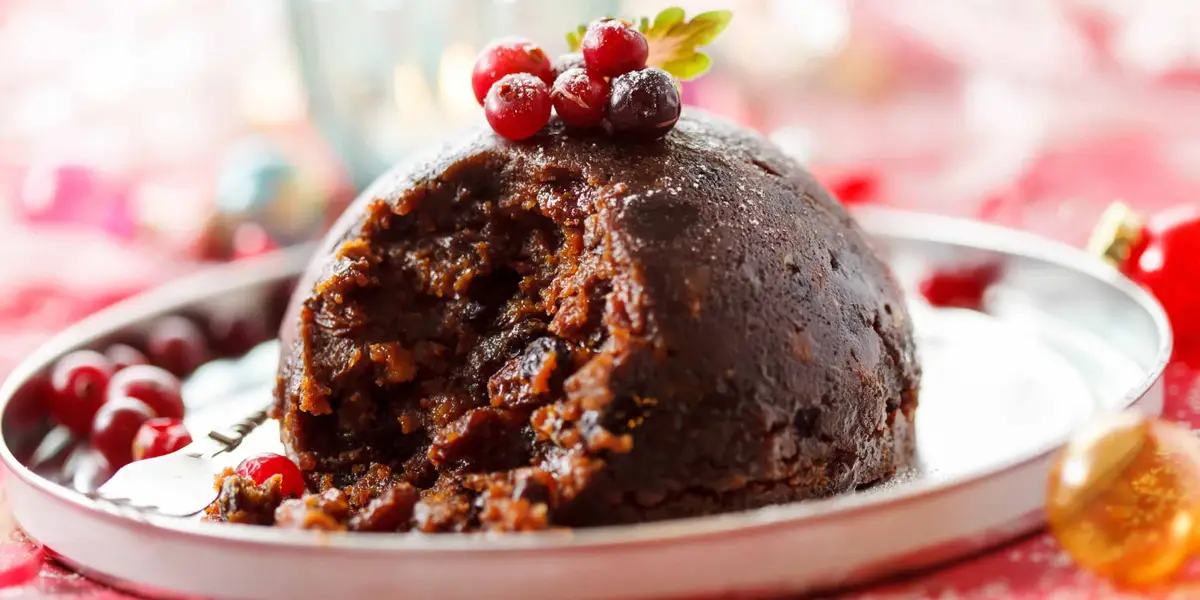
Christmas pudding is a traditional British dessert popular during the holiday season.
Christmas pudding.
Shutterstock
A Christmas pudding is a dense fruit cake often made weeks or even months in advance. This process allows the dried fruit to absorb the alcohol that’s regularly poured onto the cake in the weeks leading up to consumption.On Christmas, the cake is set alight and then topped with a sauce of brandy butter or rum butter, cream, lemon cream, ice cream, custard, or sweetened béchamel. It is also sometimes sprinkled with caster or powdered sugar.For many years, Queen Elizabeth II even gifted each member of her staff a Christmas pudding from Tesco.
Another dessert of choice is Christmas cake, a rich fruit cake covered with marzipan and icing.
Christmas cake.
nelea33/Shutterstock
While fruit cake is certainly a polarizing dessert wherever you are, Brits seem to make it a little better with thick, sweet white icing. Often, Christmas cake is also topped with festive holly decorations.
Mince pies are pastries filled with dried fruits and spices, traditionally eaten at Christmas.
Mince pies.
Getty Images
The BBC reported that the first-known mince pie recipe dates back to an 1830s English cookbook. By the mid-17th century, people reportedly began associating the small pies with the Christmas season.At the time, they were traditionally filled with pork or other kinds of meat, sage, and other spices. Nowadays, the pies are filled with dried fruits and sugar powder.
British Christmas desserts are often enjoyed with brandy butter.
Christmas pudding and brandy butter.
Monkey Business Images/Shutterstock
The perfect accompaniment to Christmas pudding and mince pies, brandy butter consists of butter and sugar beaten together, with brandy added last. Rum butter is an alternative.The result is still butter-like in consistency, and it’s served cold alongside desserts. Americans might know it as “hard sauce.”
Brits say “Happy Christmas” instead of “Merry Christmas.”
“Merry Christmas” lit-up sign.
Johnnie Pakington/Getty Images
You might remember a scene from the first “Harry Potter” movie in which Ron says, “Happy Christmas, Harry!” While this may sound strange to an American, saying “Happy Christmas” is commonplace in the UK, as opposed to “Merry Christmas.”
Christmas crackers are cardboard tubes wrapped in brightly colored paper and twisted at each end, which two people pull for a fun surprise.
Girl pulling a Christmas cracker at the dinner table.
PeopleImages/Getty Images
Christmas crackers are often pulled at the start of the meal, and the paper hats found inside are worn throughout the meal. Also inside each cracker is a “banger,” which makes a loud pop when the cracker is pulled, a joke, and a small prize.The jokes are usually cheesy and festive. For example: “Why did Santa’s helper go to the doctor? Because he had low elf esteem!” However, be sure not to pack them if you’re traveling to or from the UK on an airplane — they’re not permitted to go through TSA in carry-on luggage.
“Top of the Pops” is a television special featuring performances of the year’s most popular songs.
A stage with the “Top of the Pops” logo.
Phil Dent/Redferns/Getty Images
On Christmas, the BBC typically airs a holiday special of the since-retired show “Top of the Pops,” featuring performances from the year’s most popular musicians.The program ran weekly from 1964 until 2006, when it was canceled. People were so upset that the BBC decided to keep the Christmas special, which airs late in the morning on December 25.
Millions of people watch the King’s annual televised Christmas Day speech every year.
King Charles III is seen during the recording of his first Christmas broadcast.
Victoria Jones – Pool/Getty Images
Every year, families gather to watch the royal Christmas address, informally known as the Queen’s or King’s speech.The Telegraph reported that the first Christmas address was 251 words long, but Queen Elizabeth II later came to average 656 words in each speech. It is often one of the most-watched television programs on Christmas Day in the UK.
Christmas commercials are as talked-about as Super Bowl commercials are in the United States.
People watching TV with mugs.
Hoxton/Sam Edwards/Getty Images
While Super Bowl commercials are highly scrutinized in the US, Brits pay just as close attention to Christmas commercials.Not only is the John Lewis ad, or “advert,” a Christmas tradition, but almost every supermarket and clothing brand tries to get in on the buzz with a talked-about Christmas commercial.
Brits also anticipate which song will become the annual “Christmas No. 1” single.
The Spice Girls.
Getty Images
The British “Christmas No. 1” has been a tradition for over 50 years. Starting in 1952, the top song on the British singles chart has been a coveted spot every Christmas. Christmas No. 1 alums include The Beatles, Queen, Ed Sheeran, and more.While some Christmas No. 1s have indeed been Christmas songs — “Do They Know It’s Christmas?” by Band Aid II in 1989, for example — they don’t have to be.
School nativity plays are a popular tradition in UK primary schools.
Year one pupils from Kingsmead School perform in their annual Christmas nativity play.
Gideon Mendel/In Pictures/Corbis/Getty Images
While religious elementary schools in the United States may put on nativity plays, they are arguably much more popular and part of the culture in Britain.In the popular British Christmas movie “Love Actually,” the characters even attend a Christmas nativity play.
Brits take advantage of after-Christmas sales on Boxing Day.
Boxing Day sale signage at Selfridges department store in London.
Getty
Boxing Day is often referred to as the British equivalent of Black Friday, but there are notable differences between the two holidays. Boxing Day, which is a public holiday in the UK, falls on the day after Christmas and has a rich cultural history in Great Britain.Originating in the mid-1600s, the day was traditionally a day off for servants. On this day, servants would receive a “Christmas Box,” or gift, from their master. The servants would then return home on Boxing Day to give “Christmas Boxes” to their families.
In the UK, it can be bad luck to keep your decorations up for more than 12 days after Christmas.
A Christmas tree with a handmade ornament.
Peter Lourenco/Getty Images
Another difference between US and UK Christmas customs is evident after all the festivities have ended. In the UK, it’s tradition to take down your tree and decorations 12 days after Christmas — known as Twelfth Night — to avoid bad luck in the new year.In the Anglican tradition, Twelfth Night, or Epiphany Eve, is the day before Epiphany, which celebrates the coming of the Magi to baby Jesus and marks the end of the 12 days of Christmas.
Δημοσιεύτηκε: 2025-12-07 15:12:00
πηγή: www.businessinsider.com